2 min read
7 Technical Ways to Reduce Revenue Leakage in On-Street Parking
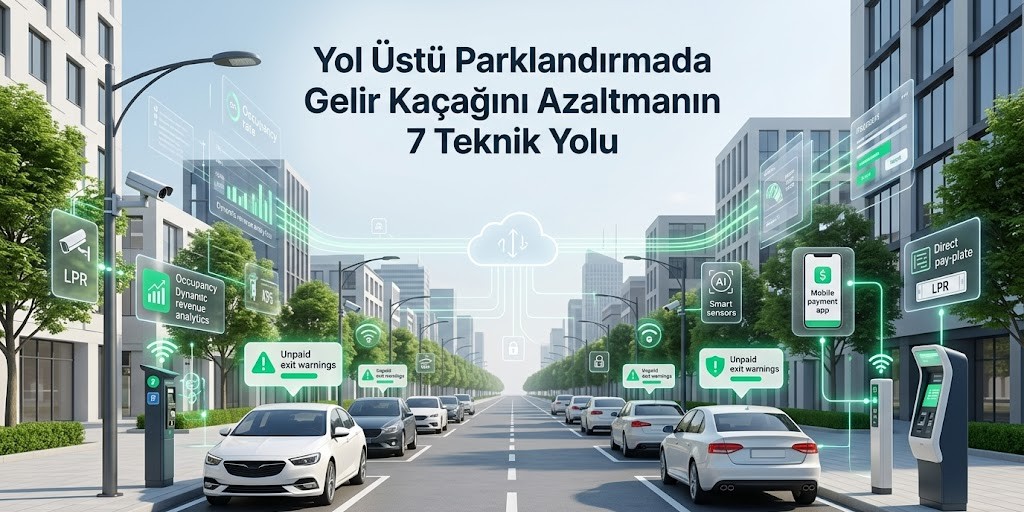
In on-street parking operations, invisible revenue leakage is one of the biggest cost items. Untracked exits, incomplete collections, incorrect duration calculations, and manual processes can significantly reduce total revenue.
Here are 7 practical technical methods you can apply in the field.
1) Deduplicate Entry/Exit Events
If the same vehicle produces multiple events, reports become inconsistent. Use a plate + timestamp + location deduplication rule.
2) Centralize Duration and Pricing Rules
Different manual pricing rules across locations create collection gaps. Manage free time, tariffs, and penalty thresholds from one rule engine.
3) Monitor Plate Recognition Accuracy
Wrong or missing plate reads directly cause revenue loss. Track camera angle, lighting quality, and confidence scores continuously.
4) Increase Payment Channel Diversity
Single-channel payment setups increase failed collections. Use a hybrid model (kiosk, mobile, plate-based payment, HGS).
5) Use Real-Time Alerts and Audit Flows
End-of-day detection is too late. Trigger alerts for unpaid exits, overstays, and repeated violations.
6) Run Daily Reconciliation
Vehicle count and paid transaction count should align. Generate a daily automatic reconciliation report and act on deviations.
7) Compare Performance by Location
Leakage reasons vary by site. Compare metrics such as unpaid-exit ratio and hourly revenue to find problematic locations quickly.
Conclusion
Reducing revenue leakage requires not one feature, but a full operational discipline: accurate data collection, automated control rules, and continuous monitoring.